More Ways to Transform Your Hotel Operations
Expert insights, case studies, and strategies from hotels using AI to boost revenue and delight guests
Published · Updated · By HelloShift Team
Short answer: hotels schedule the work they can predict and type out the rest by hand, and that hand-logged work skews maintenance: 33% of all the tasks hotel teams assign, ahead of housekeeping at 30%. At properties that still schedule housekeeping daily, guests turn the attendant away about one visit in twelve before anyone invites them to skip. Roughly 60% of the messages hotels send guests are automated, a share that has held between 57% and 61% for three years. Room inspections fail their property’s own pass threshold on 3 to 4% of runs, a first-pass rate above the industry’s common 90% target.
Hotels run on software that remembers. Since 2014, HelloShift has been the system where hotel teams log the actual work of running a property: the leaking shower head, the room that needs a deep clean, the guest arriving at midnight, the text asking whether the pool is open. That log now spans twelve years of tasks, messages, inspections, and room records, created by hotel teams while doing the work.
The HelloShift Hotel Operations Index is an aggregate look at what all of that activity says about how hotels actually run. No surveys, no self-reporting. All figures in this report are aggregate percentages, rates, and durations. No volumes, property counts, or guest information are included.
The headlines: Across a decade of operational records, the work hotels log by hand skews maintenance, while cleaning and inspections run on schedules. Guests turn away a scheduled housekeeping visit about one time in twelve without being asked. And roughly 60% of the messages hotels send guests are automated, a share that predates the current AI wave and has not moved since.
Hotels schedule the work they can predict. Room cleans go out as housekeeping assignments. Recurring inspections and preventive maintenance run as checklists. Each of those lives in its own system and never becomes a typed-out task. What is left is the exception, the thing somebody writes down and routes to a department, and that work skews maintenance. Of all the tasks hotel teams assigned in the last twelve months, maintenance is the largest category at 33%, ahead of housekeeping at 30%, with front desk at 10%. A further 26% went to named individuals rather than to a department and are not categorized here. Counting only the tasks routed to a department, maintenance is 45% and housekeeping 41%.
The finding is not that hotels do more maintenance than cleaning. They do not. It is that cleaning is planned and maintenance interrupts. Housekeeping shows up in this measure only when something falls outside the schedule; maintenance shows up whenever the building does something unscheduled, which is most of the time.
Completion rates are strong across the board: 96% of maintenance tasks get done, 93% of housekeeping tasks, and 98% of front desk tasks. Hotel teams close what they open. The surprise is not discipline, it is where the volume lands: the building itself is the biggest job in the building.
The post-pandemic debate about housekeeping opt-outs has mostly been argued from guest surveys and from programs that reward guests for skipping. Room-attendant workflows record something narrower and, we think, more useful: what happens when the attendant actually arrives. At properties that still schedule every occupied room for daily service, the attendant met a do-not-disturb sign or a declined service on 8.3% of scheduled visits, about one in twelve. The strict do-not-disturb rate alone was 7.0%. Nobody offered these guests points or a text prompt to skip. This is the unprompted floor.
Two things keep that figure conservative. The denominator includes departure rooms, where there is no guest left to decline, so among stayover rooms alone the rate runs higher. And it counts only properties that still put every room on the board every day; a hotel that has moved to service on request never records the skipped day at all. Industry surveys have found that most guests say they would rather not have daily cleaning (AHLA, 2022), and hotels that invite guests to opt out report rates several times higher than one in twelve. The gap between that and the unprompted floor is the real finding: most housekeeping opt-out is created by asking.
The cleans themselves are well documented too. At the typical property the median clean runs about 31 minutes, in line with the industry’s usual 25 to 35 minute benchmark for a departure room. The fleet-wide trimmed mean is lower, about 21 minutes, because a few high-volume properties clean faster and pull the average down.
Of the messages hotels sent guests through the platform in 2025, roughly 60% were automated: lifecycle and trigger messages such as booking confirmations, pre-arrival instructions, and checkout follow-ups. Messages drafted by AI were well under 1% of the total. Two things about that number matter more than the number itself. It is measured on hotels that already run a messaging platform, so it describes automation in practice rather than in principle; vendors routinely claim that 80% or more of guest messages can be automated. And it has barely moved. The automated share has held between 57% and 61% in each of the last three years, drifting slightly down rather than up. The automation of guest communication happened before the current AI wave, and the AI wave has not yet changed the mix.
The volume does not stop when the lobby empties, either. Roughly one in six inbound guest texts arrives between 7pm and 7am local time. That is a night-shift workload that never rings a phone.
Room and quality inspections fail their property’s own pass threshold on 3 to 4% of runs, and that rate has sat between 3% and 4% every year since 2024. Inspection volume before 2024 was too low to compare year over year. Read the other way, 96 to 97% of inspected rooms pass first time, against a commonly cited industry target of 90%.
That consistency is the finding. Inspections do not finish. A well-run hotel is not one that eventually stops finding problems; it is one that keeps looking at a constant rate and catches the roughly one room in thirty that needs fixing before a guest finds it first. Quality assurance in hotels is a permanent function, not a project.
A dataset like this exists because the modules were never separate products. HelloShift started in 2014 as a digital logbook and staff collaboration feed for hotel teams, then added guest messaging, housekeeping and maintenance management, contactless check-in, and the AI front desk, each built into the same application on the same data model. Twelve years of tasks, messages, inspections, and room records live in one place, which is what makes an index like this possible. For how that contrasts with the consolidation happening elsewhere in hotel software, see our piece on what the consolidation wave means for hotel operations software.
Finding 1 measures ad-hoc tasks only, and its categories are the assigned department rather than the task subject. Three kinds of routine work sit outside it entirely. Daily room cleaning is recorded as housekeeping room assignments, a separate record type that never becomes a task. Recurring inspections and preventive maintenance are recorded as checklist runs, which this measure excludes. Unassigned tasks are excluded as well. Within what remains, a task counts as Maintenance, Housekeeping, Front Desk or Sales when it is routed to a department account of that name; tasks assigned to a named individual, 26% of the twelve-month set, are not categorized. Read Finding 1 as a statement about unscheduled work, not about total hotel labor, and note that the excluded routine volume is not evenly split between the categories. Finding 2 counts every scheduled housekeeping visit, including departure rooms where no guest is present to decline, at the properties that run housekeeping through the platform; the stayover-only rate is higher and was not computed for this edition. A few high-volume properties account for a large share of tracked cleans, which is why the fleet-wide mean and the typical-property median differ. A Finding 4 “fail” is a completed inspection that scored below the pass threshold the property itself configured.
All figures are aggregate percentages, rates, and durations computed across the platform’s records since 2014; current-operations figures (task mix, do-not-disturb rates, after-hours share) reflect the trailing twelve months on the active fleet. Checklist line-items are excluded from task counts, matching the platform’s own reporting; task and checklist figures never overlap. Cleaning durations are trimmed to 1-240 minutes; means are computed on trimmed sums, and medians are computed per property, then aggregated. After-hours is defined as 7pm-7am in each property’s own timezone. “Automated” means lifecycle and trigger messages; AI-drafted messages are counted separately and included in the automated share. No volumes, property counts, or guest information are included, and no guest content was read or reproduced.
HelloShift is an AI-powered hotel operations platform for guest messaging, AI voice, housekeeping, maintenance, and contactless check-in. 350 Townsend Street #730, San Francisco, CA 94107.
HelloShift Team
Among all the tasks hotel teams assign, maintenance is the largest category at 33%, ahead of housekeeping at 30% and front desk at 10%. Counting only tasks routed to a department, maintenance is 45% and housekeeping 41%. This does not mean hotels do more maintenance than cleaning. Daily room cleans are scheduled as room assignments and recurring inspections run as checklists, so neither appears in this measure.
At properties that still schedule every occupied room for daily service, room attendants met a do-not-disturb sign or a declined service on 8.3% of scheduled visits, about one in twelve, with 7.0% strict do-not-disturb. That is the unprompted rate. Hotels that invite guests to skip report opt-out rates several times higher.
At the typical property the median clean runs about 31 minutes, in line with the industry's usual 25 to 35 minute benchmark for a departure room. Across all tracked cleans the trimmed mean is about 21 minutes, pulled down by a few high-volume properties that clean faster.
Roughly 60% of the messages hotels sent guests through the platform in 2025 were automated: booking confirmations, pre-arrival instructions, checkout follow-ups and similar trigger messages. AI-drafted messages were under 1%. The automated share has held between 57% and 61% for three years. About one in six inbound guest texts arrives between 7pm and 7am.
Room and quality inspections fail their property's own pass threshold on 3 to 4% of runs, meaning 96 to 97% pass first time, and that rate has sat between 3% and 4% every year since 2024. Inspection volume before 2024 was too low to compare.
It is aggregate first-party data from hotels running HelloShift, drawn from the tasks, messages, inspections and room records their teams logged while doing the work. No surveys and no self-reporting. All figures are percentages, rates and durations; no volumes, property counts or guest information are included.
Columbia Hospitality integrated HelloShift with Oracle OPERA Cloud, achieving improved operations and guest engagement through better communication and enhanced staff efficiency across their portfolio.
Move beyond walkie-talkies and paper checklists. HelloShift brings housekeeping, guest messaging, AI call answering, and task management into one platform, streamlining operations for hotels of all sizes.
Ready to transform your hotel? Get started in 5 minutes with our free trial, or schedule a demo to see HelloShift in action at a property like yours.
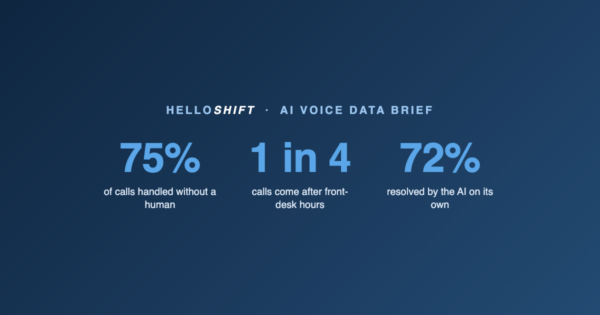
From our own call data: Across 15 months of AI-answered guest calls, about 1 in 4 arrived outside 8am to 6pm front desk hours. Read the analysis.
Expert insights, case studies, and strategies from hotels using AI to boost revenue and delight guests